
Stein Institute for Research on Aging & Center for Healthy Aging
Letter from our Director, Dr. Alison Moore
We are dedicated to the development and application of the latest advances in biomedical & behavioral science knowledge to issues of successful, healthy aging and the prevention & reduction of the burden of disability and disease.
Welcome Associate Directors!
We are thrilled to welcome four new associate directors: Maria Rosario (Happy) G. Araneta Ph.D., MPH, Sarah Banks Ph.D., Colin Depp, Ph.D., and Benjamin Smarr, Ph.D.

Public Lecture Series
The Stein Institute for Research on Aging and Center for Healthy Aging offer free public lectures promoting physical and mental well-being and staying active throughout life. Join us for this popular series with renowned researchers and clinicians sharing their expertise with the community.
Healthy Longevity Symposium 2023
Thank you to those who attended our Healthy Longevity Symposium in October! For those who could not attend, we have several videos available on UCTV. Please visit our symposium page for video links and photos!


Understanding Aging in the Real World: What Wearable Devices Reveal About How We Age Differently with Benjamin Smarr
Benjamin Smarr Ph.D. discusses wearable tech in health research, stressing community engagement in data sharing. He explores sensors tracking temperature, heart rate, and more, noting the importance of naps for health. Smarr addresses reliability, access, and the link between sleep and conditions like dementia. He mentions ongoing research beyond temperature tracking, emphasizing inclusivity and health factors' consideration.
San Diego Alzheimer's Disease Resource Center for Minority Aging Research
We are pleased to report that the San Diego Alzheimer's Disease Resource Center for Minority Aging Research (AD-RCMAR) P30 has been successfully renewed under the leadership of our Interim Director, Dr. Alison Moore. They now have additional funding from the National Institute on Aging for the next five years to provide support and resources for early-career investigators from diverse backgroundscommitted to behavioral and social science research in Alzheimer's Disease and Related Dementias (ADRD) and address ADRD inequities through novel research targeting multilevel factors to inform interventions. The Center’s population focus has evolved to be inclusive of groups with disproportionate risks for ADRD and of particular importance here in the San Diego region, including Hispanic/Latino, Limited English Proficiency, and Refugee Communities. The center will continue to benefit from the strong leadership of faculty from both UC San Diego and San Diego State University. We are very excited for all involved who have received this renewed funding!

Medical Student Training in Aging Research (MSTAR) Program
What's Happening
Leadership Transition
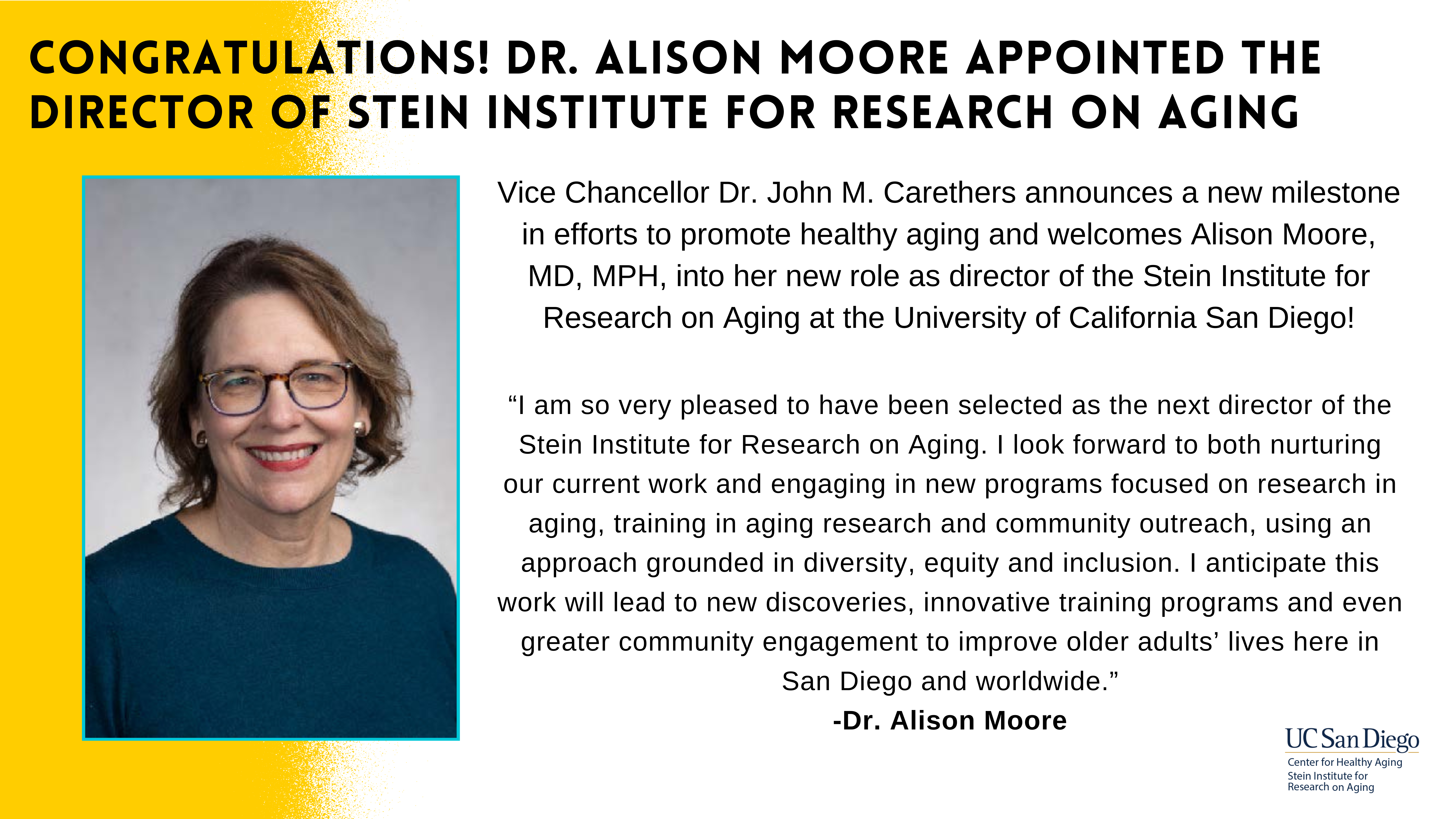
We are pleased to announce that Alison A. Moore, MD, MPH, FACP, AGSF, has been named Director for the Stein Institute for Research on Aging and the UC San Diego Center for Healthy Aging, following the retirement of Dilip Jeste, MD.
Congratulations to Kevin Yang
Kevin Yang is the recipient of the 2022 Stein Institute's Jackuelyn Harris Award for Excellence in Aging Research!
News...


Support the Center
Please consider donating to our mission! Your donations fund age related research, community events, they allow us to train the doctors of tomorrow, and much more.